
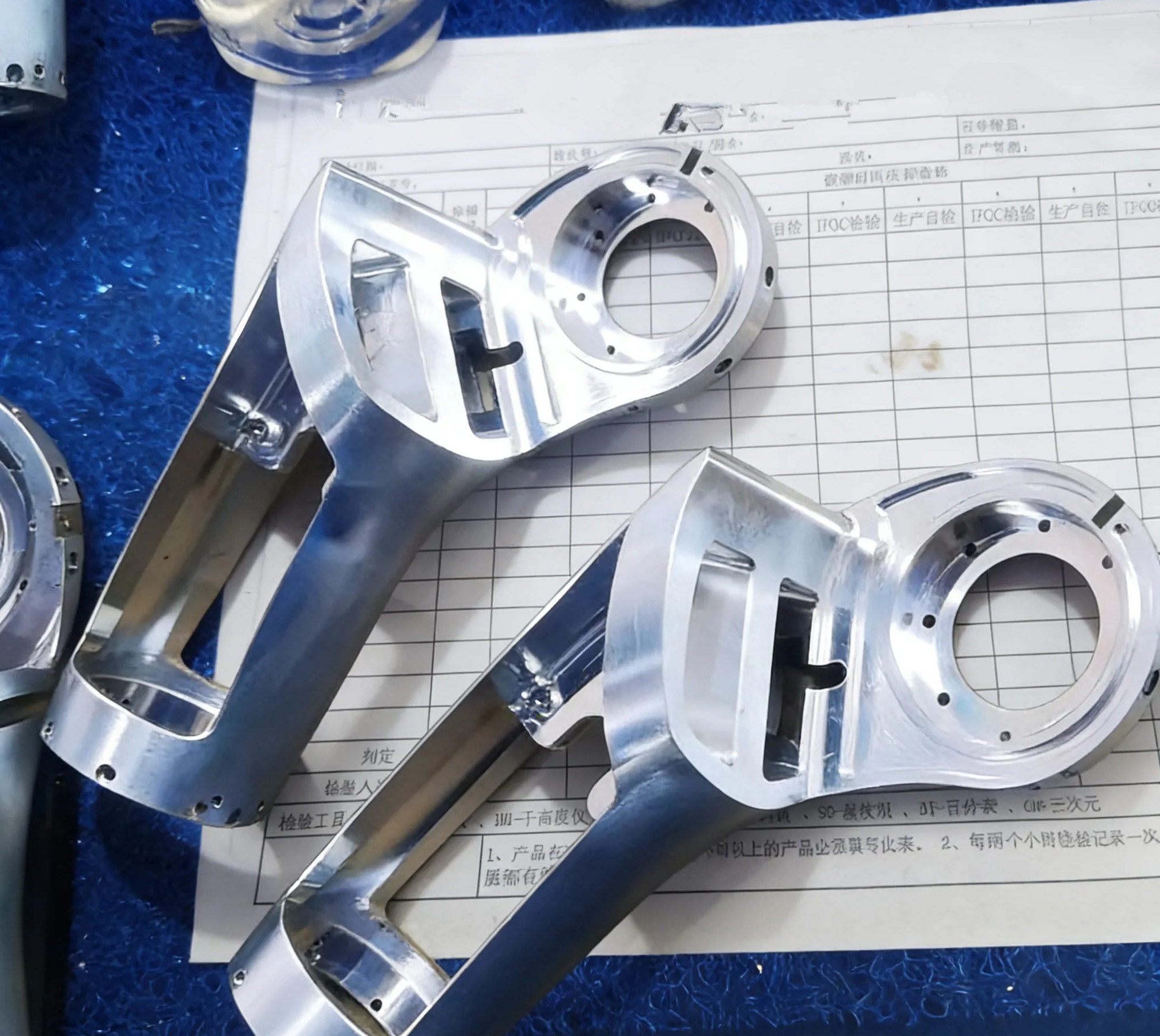
Joint Precision and Motion Stability in Robotic Systems
In robotic systems, joint components influence how smoothly motion is transferred through arms, wrists, and modular connectors. When tolerances are inconsistent across rotating interfaces or hole systems, issues can appear during testing — such as increased friction, vibration at specific angles, or small misalignments that accumulate along the kinematic chain. These effects are especially visible in lightweight robotic arms and collaborative platforms where repeated motion cycles are common.
To address these challenges, robot joint CNC machining is applied to produce parts with controlled dimensional relationships and stable assembly interfaces. Rather than relying on a single universal method, the machining route is selected according to each feature’s geometry, wall thickness, and required tolerance zone.
Structural Joint Bodies — Stable Interfaces for Load Transfer
In robotic arm parts machining, joint bodies and bracket-type structures often carry bending loads from arm sections into rotating modules. For these parts, flat mounting faces and intersecting bores must remain consistent after assembly.
-
Planar faces are finished with calibrated face-milling steps.
-
Reference edges are retained for alignment during multiple setups.
-
Hole groups are positioned through coordinated boring operations.
When joint housings include thin ribs or extended walls, roughing and finishing are divided into stages to control deformation. This approach supports stable fit during assembly without overstating achievable tolerances.
Rotational Sleeves, Couplers, and Shaft Interfaces
Rotational components in robot joint CNC applications require attention to coaxiality and surface uniformity. Shaft sleeves, couplers, and circular bearing seats are machined according to their role in motion transfer.
-
Turn-milling maintains concentricity across stepped diameters.
-
Reaming improves repeatability in paired bearing bores.
-
Surface finish is tuned to reduce friction in long-cycle operation.
Clamping strategies are adapted for thin-wall circular sections to avoid ovality. This helps preserve roundness in parts used in compact wrist or elbow modules.
Titanium Robot Components — Strength with Controlled Machining Heat
Some robotic assemblies apply titanium robot components where strength-to-weight ratio and fatigue resistance are priorities, such as joint hinges, connection links, or compact structural inserts. Machining titanium requires attention to heat generation and tool engagement.
-
Tool paths are arranged to stabilize cutting loads.
-
Step-down passes limit local temperature buildup.
-
Final finishing is reserved for tolerance-critical areas.
Instead of pursuing unnecessary surface cosmetics, the focus remains on dimensional consistency, interface flatness, and reliable fastening points suited to functional testing.
Internal Cavities and Multi-Face Features in Robotic Joints
Certain robotic joint housings integrate cable channels, actuator pockets, and multi-face mounting points. In robotic arm parts machining, the sequencing of pockets and trimmed edges affects both accessibility and accuracy.
-
Open faces are processed first to maintain rigidity.
-
Deep cavities use tool lengths matched to depth to reduce vibration.
-
Remaining local features are finished after reference faces are stabilized.
This approach supports assemblies where internal clearances, connector routing, and bearing seats must work together within a compact design envelope.
Process Selection — Matching Geometry to Manufacturing Strategy
In precision machining for robot joints, the production route is determined by geometry rather than by material alone. Typical choices include:
-
Thin-wall joint housings — staged roughing followed by light finishing
-
Shaft collars and circular rings — turning combined with secondary finishing
-
Multi-face connection brackets — 5-axis positioning to reduce setup transfers
-
Hole system alignment — coordinated boring for positional consistency
By aligning the machining strategy with functional requirements, assemblies can be evaluated across prototype and pilot-run stages without unnecessary rework.
Application Scenarios Across Robotic Platforms
robot joint CNC machining is commonly applied in:
-
robotic arm elbow and wrist joints
-
humanoid robot limb connectors
-
collaborative robot modular joints
-
titanium robotic arm reinforcement links
-
actuator and gearbox interface housings
-
research-grade motion test assemblies
Use cases range from prototype development to low-volume engineering builds where design revisions and tolerance adjustments are expected during iteration.
Balancing Performance, Cost, and Development Speed
Instead of replacing casting, sheet metal forming, or additive processes, CNC machining works alongside them as a practical solution for:
-
functional prototypes
-
engineering validation parts
-
precision-critical interfaces
-
low-volume pilot production
The emphasis remains on consistent fit, predictable assembly behavior, and compatibility with downstream motion testing — without overstating performance outcomes or introducing unsupported claims.