
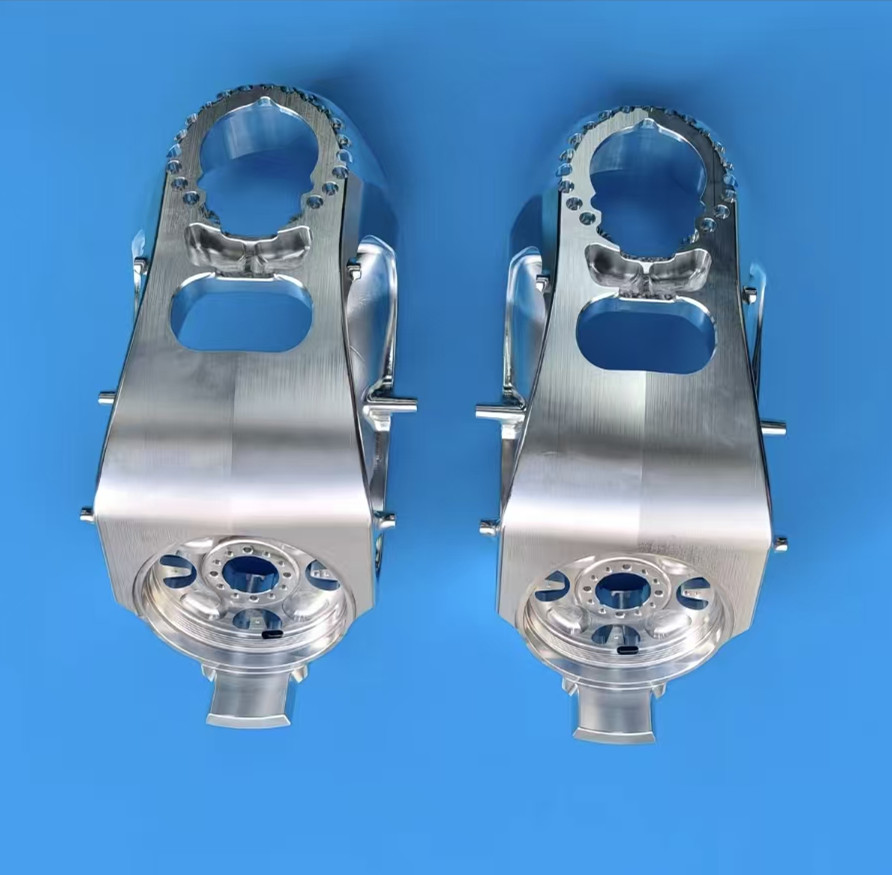
When Robotics Designs Move from Digital Models to Functional Assemblies
In many robotics projects, the transition from CAD simulation to real-world assembly exposes issues that are not visible on screen. Thin-wall panels may deform during cutting, precision holes may shift between setups, and joint housings sometimes fail to align with mating parts. These problems become critical in precision robot components, where multiple fastening points, structural ribs, and alignment bosses must remain consistent to support stable motion and repeatable assembly.
Rather than applying a single machining approach to every part, a process-driven workflow evaluates component geometry, stiffness behavior, tolerance sensitivity, and loading areas before deciding how each feature should be manufactured.
The goal is not only dimensional accuracy — but predictable structural behavior during testing and refinement.
Application Scenarios for Precision Robot Components
CNC-machined precision robot components are widely used in:
-
humanoid robot torso frames and structural plates
-
robotic arm housings and joint cover modules
-
sensor bracketry and lightweight support frames
-
autonomous platform chassis components
-
prototype robotic testing units
-
electronic bay reinforcement panels
Across these scenarios, components often serve both structural and functional roles. They must support wiring passages, mounting interfaces, and mechanical load distribution without introducing unnecessary weight or assembly interference.
Early-stage builds typically prioritize:
-
structural stability
-
repeatable mounting alignment
-
controlled dimensional behavior across iterations
instead of purely cosmetic finishing goals.
Process Selection Based on Shape, Wall Thickness, and Tolerance Needs
For precision robot components, machining strategies are chosen according to how the part behaves under cutting forces rather than only material type.
Examples of process-specific handling include:
-
thin-wall frames → staged roughing to minimize distortion
-
deep pockets and housings → balanced tool engagement to control deflection
-
multi-face brackets → unified datum reference for consistent alignment
-
curved outer shells → multi-axis machining to maintain contour flow
Features with higher assembly sensitivity — such as joint interfaces, shaft bearing seats, and alignment bosses — are often reserved for a final finishing pass tied to a stable reference plane.
This helps maintain relative position accuracy without overstating tolerance capability.
Material choice also influences manufacturing decisions:
-
aluminum alloys for lightweight structural panels
-
stainless steel for reinforcement and load points
-
titanium where localized stress resistance is required
Surface treatment is selected according to application needs, especially when parts will continue through testing or re-machining phases.
Precision Robot Components in Prototype and Low-Volume Development
During early design and validation cycles, many robotic assemblies require ongoing refinement. Machined precision robot components support this workflow by allowing:
-
geometric verification of internal layout
-
observation of wiring and fastener access paths
-
assessment of structural response under movement
-
fine-tuning of mounting hole locations and joint relationships
This makes CNC machining an effective bridge between:
-
digital design
-
physical prototype
-
pre-production functional assemblies
without committing prematurely to large-scale tooling.
Matching Machining Methods to Functional Zones of Each Component
Different areas within a single part may require different machining strategies:
-
reinforcement corners are protected to preserve stiffness
-
mounting faces are finished last to retain datum consistency
-
hole systems are grouped in a common setup where feasible
-
internal pockets balance weight reduction and rigidity
This approach allows precision robot components to support structural function while maintaining assembly practicality.
It is especially useful in:
-
torso support plates for humanoid robots
-
joint connection housings
-
robotic shoulder, hip, and wrist frame structures
-
modular research robot platforms
where repeated iteration and partial redesign are typical.
Low-Competition Engineering Keywords Embedded Through Context
The production workflow naturally aligns with specialized technical searches such as:
-
structural machining for robotics prototypes
-
low-volume precision robotics parts
-
functional test assembly CNC services
-
multi-axis robotic frame machining solutions
These phrases help reach engineering teams researching practical solutions rather than broad consumer-level topics.
Conclusion — A Function-Driven Approach to Precision Robot Components Manufacturing
The development of modern robotic systems benefits from a manufacturing approach where shape, tolerance priority, and material behavior determine the machining strategy. By emphasizing datum planning and controlled finishing, precision robot components support reliable assembly fit and stable structural performance through multiple development stages.
This process-based method allows engineering teams to evaluate real-world functionality, refine geometry, and move forward with greater confidence as designs progress toward pre-production.