
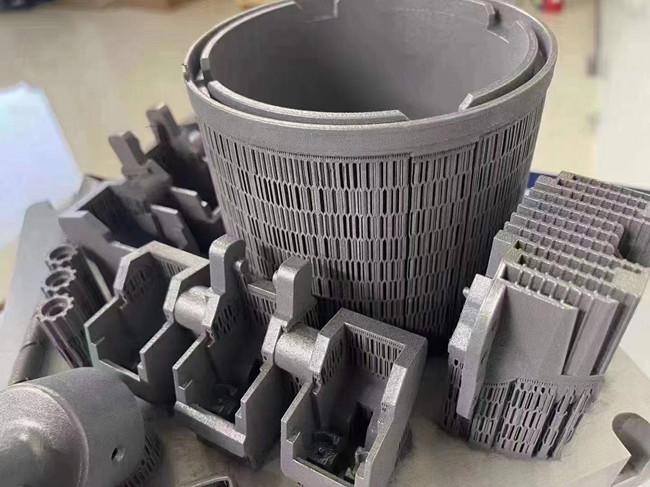
Revolutionizing Manufacturing with Precision Metal 3D Printing
In today's fast-paced industrial landscape, businesses grapple with excruciatingly long lead times (often 8–12 weeks), prohibitively high costs (due to expensive tooling), and the inefficiencies of low-volume production runs (under 500 units). Our Metal 3D Printing Service eliminates these barriers by leveraging advanced 3D printing metal technologies like Selective Laser Melting (SLM) and Direct Metal Laser Sintering (DMLS). This enables us to deliver high-precision, custom metal parts in as little as 3–7 days, slashing costs by up to 55% for orders ranging from 1 to 1,000 units. Unlike traditional methods, our process requires zero tooling investments, making it ideal for prototypes, bridge production, and end-use components across diverse sectors.
Mission-Critical Application Scenarios
Our 3D print metal expertise solves real-world challenges in industries where complexity, speed, and customization are paramount. Below, we outline key applications, emphasizing how our service addresses chronic issues like extended timelines and budget overruns for small batches.
- Aerospace & Defense: Components such as satellite antenna brackets and turbine blades demand extreme precision (tolerances to ±0.05mm) and lightweight designs. Traditional CNC machining often takes weeks due to intricate setups, but our metal 3d printing service uses DMLS to produce near-net-shape parts in days, reducing weight by 30% and accelerating R&D for low-volume satellite deployments.
Integrated keyword: "Satellite antenna brackets DMLS" - Medical & Dental: For applications like micro-surgical implant metal printing, biocompatible parts (e.g., titanium spinal cages) require exceptional surface finishes (Ra < 5μm) and FDA-compliant geometries. Conventional methods incur high costs for small batches (e.g., 5–50 units), but SLM technology enables cost-effective, on-demand production with no minimum order quantities, ideal for patient-specific trials.
Integrated keyword: "Micro-surgical implant metal printing" - Automotive & Robotics: Parts such as low-run automotive hinges or robotic arms face delays from multi-stage machining. Our service optimizes 3D printing metal for complex, low-volume runs (e.g., 100–500 units), using generative design to cut lead times by 70% while maintaining ISO 9001 standards for strength and durability.
Integrated keyword: "Low-run automotive hinges prototyping" - Industrial & Consumer Electronics: Components like EMI-shielded RF enclosures need intricate internal channels for thermal management, which are costly and slow to mill. We apply binder jetting for rapid, low-cost production of small batches, enhancing EMI protection by 40% without tooling delays.
Integrated keyword: "EMI-shielded RF enclosures printing"
These scenarios underscore how our service transforms high-cost, low-volume projects into agile, economical solutions, enabling faster innovation and market entry.
Tailored Processes Based on Part Shape and Precision Requirements
The choice of 3D print metal technology is dictated by your part's specific geometry and accuracy needs, ensuring optimal results without compromising on quality. Here's how we match processes to your requirements:
- Complex Geometries (e.g., Lattice Structures or Internal Cavities): For parts with organic shapes impossible via machining, SLM or DMLS is ideal. These powder-bed fusion methods build layer-by-layer, achieving dimensional accuracies of ±0.1mm and minimizing material waste. For instance, conformal cooling molds for injection reduce cycle times in plastic molding by 25%, all while bypassing the 6–8-week lead times of traditional mold-making.
Integrated keyword: "Conformal cooling molds for injection" - High-Precision Requirements (e.g., Medical Implants or Optical Components): When tolerances below ±0.05mm are critical, technologies like Electron Beam Melting (EBM) or high-resolution DMLS are employed. This ensures surface roughness as low as Ra 3μm, crucial for FDA-approved devices. Unlike subtractive methods that require multiple setups, our single-step process cuts production time by 65% for low-volume batches.
- Medium-Complexity Parts with Cost Sensitivity (e.g., Brackets or Connectors): For simpler shapes needing cost-efficient runs, binder jetting or material extrusion (e.g., Fused Deposition Modeling with metal filaments) is used. This reduces expenses by 50% compared to CNC for quantities under 200, with lead times under 5 days.
This adaptive approach allows us to handle everything from one-off prototypes to short-series production, with real-time quality control via AI-driven monitoring to ensure every part meets specifications.
Solving Long Lead Times, High Costs, and Low-Volume Challenges
Our metal 3d printing service directly counters the pain points of conventional manufacturing:
- Reduced Lead Times: By eliminating tooling and setup phases, we compress production cycles by 60–70%. For example, a typical aerospace bracket that takes 10 weeks via machining is delivered in 2 weeks with DMLS. Rapid prototyping capabilities mean you can iterate designs in days, not months.
- Cost Efficiency for Small Batches: High upfront costs for molds and fixtures are avoided— 3D printing metal uses only the material needed, slashing expenses by up to 55% for orders of 1–500 units. Our cloud-based quoting system provides instant estimates, ensuring transparency.
- Optimized Low-Volume Production: Digital inventories allow on-demand manufacturing, so you only produce what's needed. This is perfect for low-run automotive hinges prototyping, where economies of scale don't apply, and we maintain consistent quality through automated post-processing like heat treatment and surface finishing.