
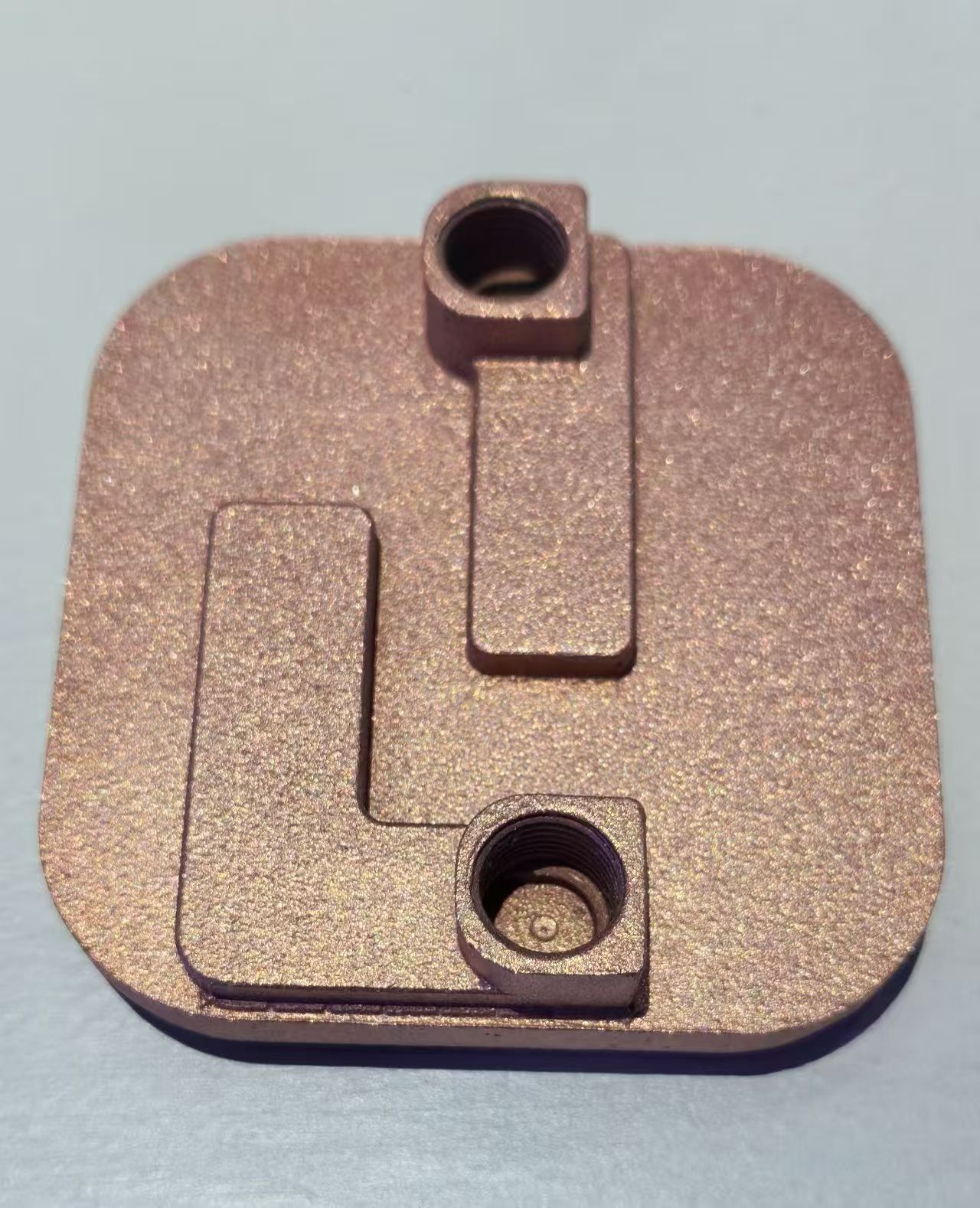
DMLS 3D Printing — solving challenges in complex geometries and functional copper components
Many engineering projects reach a point where conventional machining becomes restrictive. Tight internal channels, complex cooling paths, thin-wall structures, or organic forms can be difficult or costly to produce using subtractive manufacturing alone. When parts require both functional strength and precise dimensional stability, engineers begin exploring dmls 3d printing as a practical alternative.
Instead of forcing a design to fit traditional tooling constraints, Direct Metal Laser Sintering enables the production of metal components that follow the geometry required by performance — especially when working with copper parts that support heat transfer, thermal control, or specialized tooling environments.
This page focuses on how dmls 3d printing and industrial dmls 3d printer systems are applied to small-batch production, functional prototypes, and engineering validation builds.
Why Part Geometry and Tolerance Requirements Define the Manufacturing Route
Not every metal part is suited to a single process. In many projects, the decision between machining and metal additive manufacturing depends on:
-
internal channel complexity
-
surface accessibility
-
heat transfer requirements
-
wall thickness limitations
-
tolerance concentration zones
For components with open surfaces and simple profiles, CNC machining may remain the most direct option.
However, when a part contains internal conformal cooling channels, embedded cavities, or intricate lattice structures that cannot be drilled or milled, dmls 3d printing offers a more suitable path. Dimensional tolerances are planned around functional interfaces, while non-critical areas may retain more practical finishing values.
The approach is not about overstating capability — it is about selecting a manufacturing route that aligns with how the part is intended to perform.
Application Scenarios for DMLS 3D Printed Copper Parts
Copper materials are often used where thermal conductivity and heat dissipation are essential. With DMLS technology, engineers can create geometries that support:
-
mold inserts with conformal cooling
-
heat transfer blocks and thermal control modules
-
copper inserts for tooling and pilot production
-
high-conductivity components in testing environments
-
localized heat-sink elements in compact assemblies
In these projects, 3D printed copper parts are typically applied in:
-
tooling and mold engineering
-
automotive and motorsport thermal components
-
industrial equipment testing fixtures
-
engineering development prototypes
-
research and experimental hardware
When copper parts require both functional performance and complex channel design, dmls 3d printing provides a pathway that machining alone cannot always achieve.
How Surface Quality and Precision Are Managed in DMLS Production
Dimensional precision in DMLS metal printing is planned according to functional usage. Areas that interface with shafts, fasteners, or alignment features may undergo:
-
secondary CNC finishing
-
post-machining of key surfaces
-
tolerance refinement on mating areas
Meanwhile, internal channels and enclosed structures remain as-printed to maintain geometry continuity.
This balance allows parts to meet:
-
mechanical fit requirements
-
functional heat transfer behavior
-
realistic production constraints
Rather than applying uniform tolerances across every feature, precision is concentrated where it delivers engineering value.
Material Considerations for Copper DMLS Applications
Copper is selected in DMLS projects primarily for:
-
high thermal conductivity
-
targeted heat-flow control
-
uniform cooling performance in dense sections
Depending on application needs, different copper or copper-alloy grades may be considered to support:
-
wear surfaces
-
structural load points
-
repeated thermal cycling conditions
During early development or pilot production, parts may also be printed in small batches to validate geometry before moving toward larger-scale manufacturing decisions.
Supporting Low-Volume Builds and Iterative Engineering
Many dmls 3d printer projects are not intended for mass production at the first stage. Instead, they support:
-
engineering validation prototypes
-
functional testing components
-
short-run tooling inserts
-
pilot runs for early product launches
This approach allows design teams to:
-
test airflow or cooling channel performance
-
adjust geometry based on real-world testing
-
refine local wall thickness or support structures
Small batch flexibility is often more valuable than committing to early tooling investment when design outcomes are still evolving.
Practical Positioning: Performance Guided by Application Needs
The goal of dmls 3d printing for copper components is not to promise unrealistic results. Instead, it provides:
-
a manufacturing route for complex heat-transfer geometries
-
dimensional control focused on functional zones
-
realistic production cycles for low-volume parts
By allowing geometry to follow engineering intent, 3D printed copper parts support development environments where both performance and manufacturability must be evaluated in parallel.