
Navigating Challenges in High-Precision Custom Sheet Metal Fabrication
Finding a reliable partner for custom sheet metal fabrication often presents a significant hurdle for product engineers and procurement managers. Common pain points include inconsistent tolerances that lead to assembly failures, the inability of suppliers to handle a wide range of part sizes, and a lack of specialized expertise in sensitive industries like medical device manufacturing. When your design requires complex geometries and aesthetic finishes for external housings, standard "one-size-fits-all" processing is rarely sufficient.
How do you ensure that your medical equipment housing or industrial enclosure meets both functional protection standards and rigorous dimensional accuracy? The answer lies in a fabrication process driven by equipment capability and technical adaptability.
Engineering Precision: Process Selection Based on Geometry
In the realm of custom sheet metal fabrication, the choice of processing technology is never arbitrary. The specific shape, fold complexity, and required precision of a component dictate the workflow. For complex medical housings that require seamless corners and ergonomic curves, we utilize a combination of laser cutting and advanced CNC bending.
By analyzing the 3D CAD models, our engineers determine the optimal bend sequence to minimize material stress and prevent deformation. This technical approach ensures that whether the part is a simple bracket or a multi-faceted equipment shell, the structural integrity remains uncompromised.
CNC Bending Capabilities: Scaling from 1mm to 1500mm
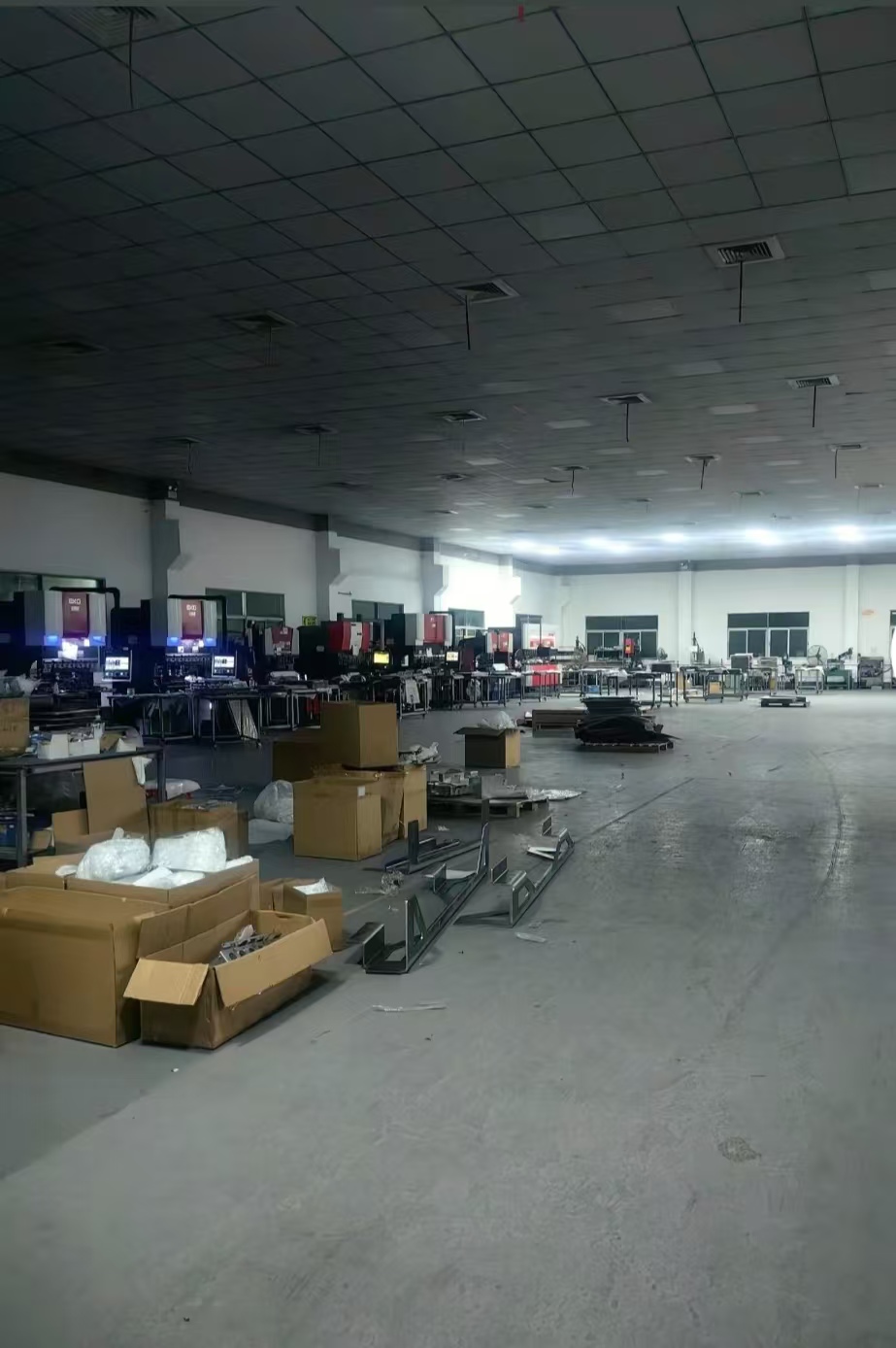
Equipment capacity is the backbone of production reliability. Our facility is equipped with 10 high-precision CNC bending machines, allowing for simultaneous processing of diverse orders and high-volume production runs.
Our capability covers a broad dimensional spectrum:
-
Minimum Processing Size: 1mm (Micro-components and internal electronic supports).
-
Maximum Processing Size: 1500mm (Large-scale industrial enclosures and medical workstations).
The integration of 10 dedicated stations means we can dedicate specific machines to specific material types (such as stainless steel, aluminum, or carbon steel) to avoid cross-contamination, which is particularly vital for medical-grade components.
Technical Parameters and Tolerance Standards
Reliability in custom sheet metal fabrication is measured by the numbers. We adhere to strict industrial standards to ensure every part fits the final assembly perfectly.
| Parameter | Specification / Capability |
| Number of CNC Bending Units | 10 Units |
| Dimensional Range | 1mm – 1500mm |
| Standard Linear Tolerance | ±0.1mm to ±0.3mm (depending on material thickness) |
| Angular Tolerance | ±0.5° |
| Material Thickness | 0.5mm – 6.0mm (typical range) |
| Surface Finishes | Powder coating, anodizing, brushing, and electropolishing |
These tolerances are critical for medical equipment housing, where internal components such as sensors, screens, and PCBs must align perfectly with the external shell.
Specialized Application Scenarios
Our fabrication services are tailored for high-stakes environments:
-
Medical Equipment Housings: We produce enclosures for diagnostic machines, ventilators, and laboratory analyzers. These parts require smooth surfaces for sterilization and precise cutouts for user interfaces and ventilation.
-
Industrial Machine Enclosures: For heavy-duty environments, we fabricate robust shells that protect sensitive electronics from dust, moisture, and mechanical impact.
-
Server and Telecommunication Racks: High-precision bending ensures that modular components slide in and out of racks without friction or misalignment.
Quality Assurance and Trust Recognition
Choosing a fabrication partner is an investment in your product's reputation. Our facility operates under a rigorous quality management system, ensuring that every batch of custom sheet metal fabrication undergoes dimensional inspection via calibrated instruments. With 10 CNC bending machines and a focus on the 1-1500mm range, we provide the scalability of a large factory with the precision of a specialized boutique shop. We focus on transparent communication, providing DFM (Design for Manufacturing) feedback to help you reduce costs without sacrificing part quality.
Frequently Asked Questions (FAQ)
Q: What materials are most commonly used for medical enclosures?
A: We typically use 304 or 316L stainless steel for its corrosion resistance and ease of cleaning, or aluminum for lightweight portable medical devices.
Q: Can you handle low-volume prototypes as well as mass production?
A: Yes. Our 10-machine setup allows us to remain flexible. We can dedicate one station to rapid prototyping while the others handle high-volume runs for custom sheet metal fabrication.
Q: How do you ensure the precision of parts up to 1500mm?
A: Large parts are prone to "bowing." We use CNC compensation systems on our bending machines to ensure the angle remains consistent across the entire 1500mm length of the fold.
Q: What information is needed for a quote?
A: Please provide 2D drawings (PDF/DWG) with tolerances and 3D files (STEP/IGS) for geometry. Also, specify the material type and desired surface finish.