
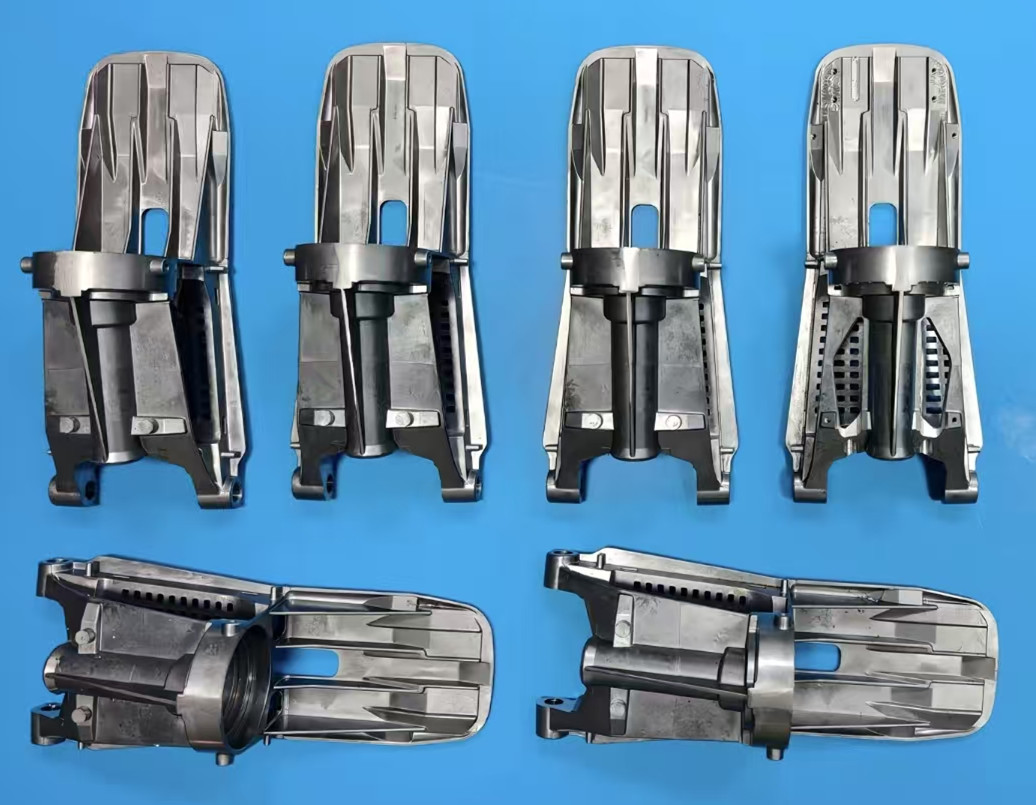
When Robotic Components Require Structural Accuracy and Stable Assembly Fit
As robotics projects move from conceptual modeling into physical validation, many engineering teams face recurring challenges: thin-wall panels may deform during cutting, hole locations may shift through repeated setups, and joint housings sometimes fail to align with surrounding assemblies. These issues become more visible in Humanoid Robot Components and modular robotic frames, where multiple connection points and structural ribs must remain consistent across iterations.
For this reason, a Custom Robot Parts Factory approach emphasizes selecting machining routes based on geometry, wall thickness, tolerance sensitivity, and loading conditions — rather than treating every part with the same process.
The objective is not only to produce parts, but to support predictable assembly behavior during testing and refinement.
Application Scenarios for Precision CNC for Robots
Components produced through Precision CNC for Robots are widely used in:
-
humanoid robot torso frames and support brackets
-
robotic arm interface housings and joint covers
-
autonomous platform chassis structures
-
research and prototype robot modules
-
sensor mounting plates and electronic carrier panels
-
lightweight reinforcement ribs and structural panels
Across these applications, mechanical function often matters more than cosmetic surface appearance. Stability of geometry, structural stiffness, and repeatable mounting alignment are typically prioritized during early production phases.
Process Selection Based on Shape and Tolerance Requirements
In Expert Robotic Machining, processing decisions are made according to part behavior rather than only material or volume.
Different structural forms require different strategies:
-
thin-wall components → staged roughing to control distortion
-
deep cavity housings → gradual pocket cutting to reduce tool impact
-
multi-face brackets → coordinated datum references for consistency
-
curved outer frames → multi-axis machining to maintain contour flow
Areas with higher assembly sensitivity — such as bearing interfaces, joint connection faces, and alignment bosses — normally receive a reserved finishing pass tied to a defined reference plane. This helps keep relative positioning stable without overstating achievable precision.
Material selection influences process planning as well:
-
aluminum alloys for lightweight humanoid frameworks
-
stainless steel for structural reinforcement points
-
titanium or hardened steel where local load is concentrated
Finishing treatments are chosen based on function rather than aesthetics, especially when components will undergo further testing or modification.
How a Custom Robot Parts Factory Supports Iterative Development
During early design stages, robotic systems frequently require design revisions after initial assembly. A Custom Robot Parts Factory approach enables:
-
geometric verification of component layout
-
evaluation of fastener access and wiring paths
-
structural response assessment under movement
-
fine-tuning of hole locations and joint interfaces
This workflow supports low-volume validation while maintaining consistent dimensional references across revisions.
Instead of competing with alternative manufacturing methods, Expert Robotic Machining works as a bridge between:
-
digital design
-
functional prototype
-
pre-production assemblies
This helps engineering teams review real-world performance without committing prematurely to large-scale tooling.
Precision CNC for Robots — Matching Machining Methods to Functional Areas
To maintain structural reliability, different sections of a single component may require different handling:
-
reinforcement corners may be finished later to preserve sharp alignment edges
-
mounting faces are processed after establishing stable datums
-
high-precision hole systems are coordinated within the same setup when feasible
-
internal cavities are balanced between stiffness retention and weight control
By treating each feature according to its functional purpose, Humanoid Robot Components can support both mechanical performance and assembly practicality.
This approach is especially useful in:
-
robot torso structural plates
-
joint housing connection rings
-
shoulder and hip framework components
-
modular robotic testing platforms
where repeated iteration and partial redesign are common during development.
Low-Competition Engineering Keywords Integrated Through Context
The product workflow naturally aligns with search intents such as:
-
low-volume robotics prototype fabrication
-
structural robot frame CNC service
-
precision assembly reference machining
-
multi-axis robotic metal component processing
These terms support professional engineering audiences researching technical solutions rather than purely commercial offerings.
Conclusion — A Process-Based Approach to Advanced Robotic Component Manufacturing
The development of Humanoid Robot Components and structural robotic assemblies benefits from a production method where geometry, tolerance demands, and material behavior determine the machining strategy. Through Precision CNC for Robots and careful datum planning, a Custom Robot Parts Factory environment enables controlled prototype evaluation and reliable assembly consistency across iterations.
By aligning machining choices with part design intent, Expert Robotic Machining supports engineering-driven progress from concept to validated functional structures.