
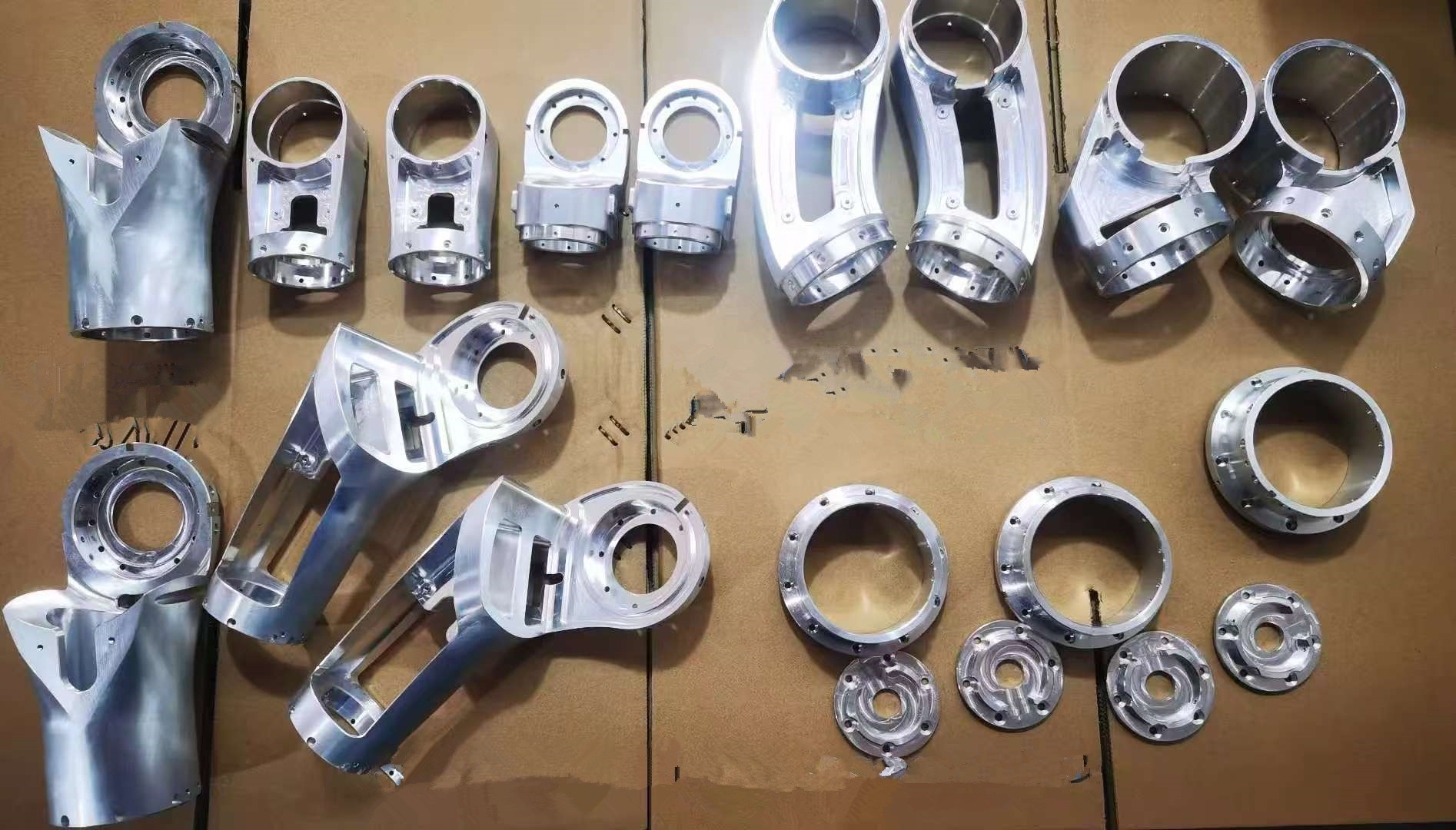
Why CNC Machining Matters in Humanoid Robotics
Developing humanoid robots requires parts that align closely with motion paths, joint loads, and control tolerances. Many components feature thin-wall structures, intersecting hole systems, or asymmetric curved surfaces. When these elements are produced with insufficient dimensional accuracy, the result can be friction in rotating joints, noise in transmission systems, or premature wear during endurance testing.
In this context, CNC Machining for Humanoid Robot Parts plays a practical role by supporting tight-tolerance prototypes and small-batch functional parts. By selecting appropriate machining strategies based on the geometry and tolerance requirements of each feature, engineers can improve assembly consistency and repeatability across iterative development cycles.
Structural Components — Frames, Brackets, and Load-Bearing Interfaces
custom robot components used in structural frames and joint brackets typically prioritize stiffness-to-weight balance. For larger housings or arm frames, materials such as aluminum alloys are commonly selected to support strength while keeping inertia low.
-
Flat mounting faces may be finished with face-milling to maintain planar stability.
-
Long, slender brackets often require stepwise roughing to control deformation.
-
Tolerance-critical hole groups are aligned using coordinated boring processes.
In precision robot manufacturing, stress-relief and finishing passes are applied when parts include extended unsupported sections. This reduces the risk of misalignment during assembly of torso frames, hip structures, or shoulder bracket interfaces.
Motion & Joint Parts — Rotational Accuracy and Surface Finish Control
Elbow, wrist, and neck modules in humanoid robots rely on smooth motion and uniform load transfer. For rotating shafts, couplers, and bearing seats, the machining method is determined by the functional surface.
-
Turn-milling can help maintain coaxiality across multi-diameter sections.
-
Reaming is applied to improve fit in paired bearing bores.
-
Surface finish is controlled to reduce friction under repeated cycles.
Where thin-wall circular housings are used, clamping strategy is adjusted to prevent ovality. This approach supports dimensional stability in joint modules without over-tightening fixtures or deforming delicate contours.
Actuator & Gearbox Housings — Internal Cavities and Heat-Sensitive Areas
In many robot architectures, compact actuator housings integrate multiple internal cavities, cable pass-throughs, and mounting points. These components require machining sequences planned around accessibility and thermal influence.
-
Pocket milling is arranged from open faces toward enclosed chambers.
-
Tool lengths are matched to cavity depth to reduce vibration.
-
Local tolerance zones are machined in a final finishing stage.
When housings are paired with high-torque gearboxes, concentricity and positional accuracy are prioritized over visual appearance. This approach supports functional reliability without overstating achievable outcomes.
Sensor Mounts, Covers, and Enclosures — Aesthetics with Functional Alignment
Not all custom robot components are purely structural. Head and chest panels, lidar mounts, and camera bezels often require visually consistent surfaces while still aligning to internal modules.
-
3-axis milling may be used on flat and gently curved faces.
-
5-axis trimming supports multi-direction edges and transitions.
-
Chamfers and radii are applied to ease assembly and reduce sharp edges.
Where transparent or composite covers are used, metal adapter plates may be machined as interface layers, allowing the enclosure to align with internal electronics without significant rework.
Process Selection — Matching Geometry to the Right Machining Strategy
In precision robot manufacturing, the process route is adjusted according to part geometry rather than applying a single universal method. Examples include:
-
Thin-wall link arms — staged roughing + finishing passes
-
Shaft collars — turning + grinding for improved circularity tolerance
-
Multi-face brackets — 5-axis positioning to reduce setup transfers
-
Hole system alignment — coordinate boring or guided drilling
This approach helps maintain dimensional relationships while supporting low-volume pilot runs and engineering change iterations.
Application Scenarios in Humanoid Robotics
CNC Machining for Humanoid Robot Parts is commonly applied in:
-
Upper limb joints and wrist connectors
-
Leg frames, ankle mounts, and balancing modules
-
Gearbox housings and actuator interfaces
-
Sensor brackets and head-mounted assemblies
-
Lightweight internal reinforcement parts
-
Prototype robot platforms and testing rigs
The emphasis is on functional fit, tolerance consistency, and compatibility with downstream validation steps such as motion testing and endurance cycling.
A Practical Manufacturing Approach for Robotics Engineering Teams
Rather than replacing other manufacturing methods, CNC machining works alongside sheet-metal forming, casting, and additive manufacturing. It is especially suitable when:
-
quantities are limited during development
-
design revisions occur frequently
-
precision in local tolerance zones is required
-
assemblies must be evaluated before scaling production