
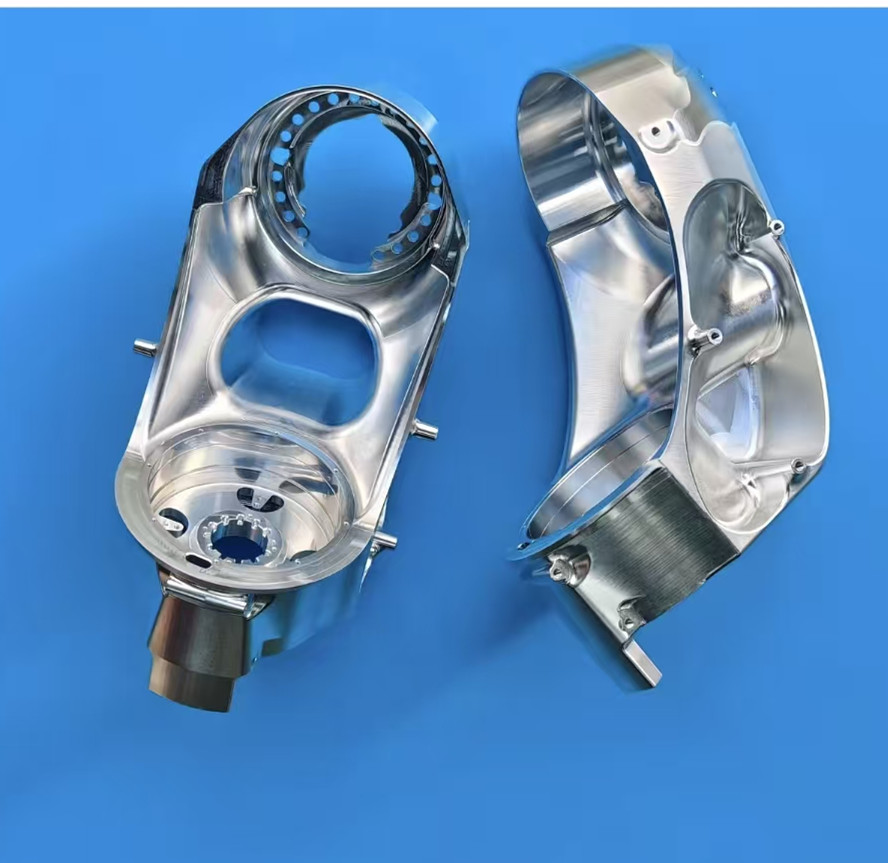
Structural Stability and Assembly Fit in Robot Chassis Development
When developing robotic systems, the chassis is not only a shell or outer frame — it is the structural foundation that supports motion modules, electronics, drivetrain layouts, and modular extension points. In early development stages, challenges often appear around flatness, mounting alignment, and internal space allocation. Small deviations in frame geometry can affect assembly fit, wiring space, or access for maintenance and testing.
For these reasons, aluminum robot chassis manufacturing is selected for projects where dimensional stability, repeatable interfaces, and controlled tolerances are preferred during prototype and low-volume production. Instead of applying a single fixed process, the machining route is matched to each feature’s geometry, wall thickness, and interface requirement.
Aluminum Robot Chassis — Lightweight Structural Base
In many applications, an aluminum robot chassis is chosen due to its weight-to-strength balance, corrosion resistance, and suitability for multi-face machining. The chassis typically integrates:
-
structural ribs
-
internal mounting pillars
-
connector windows
-
bracket interfaces
-
battery and controller compartments
To support assembly precision:
-
reference planes are established early in machining
-
stiff areas are retained during roughing
-
finishing passes are applied near final stage
This approach helps maintain dimensional relationships across large flat sections and internal compartment areas without overstating achievable tolerances.
5-Axis Robot Part Manufacturing — Complex Geometry and Multi-Face Features
Certain chassis structures and robot body modules require intersecting surfaces, curved contours, and angled mounting points. In these cases, 5-axis robot part manufacturing reduces setup transfers and improves feature alignment across multiple sides.
It is commonly applied to:
-
curved outer housings
-
integrated corner radii
-
joint mounting transitions
-
angled connector panels
With 5-axis positioning:
-
critical features remain referenced to the same coordinate system
-
chamfers, edges, and openings are processed in a single orientation
-
finishing is focused on assembly-sensitive areas
This supports functional alignment for parts that interact with arms, wheels, or sensing modules.
Internal Layouts — Pockets, Channels, and Mounting Zones
Inside an aluminum robot chassis, internal layouts vary depending on electronics placement, cable routing, and cooling requirements. Machining strategy is selected based on cavity depth and structural sensitivity.
Typical operations include:
-
stepped pocket milling for electronics trays
-
slot machining for ventilation or cable paths
-
threaded insert points for modular mounting
-
selective finishing of functional edges
Deep cavities are processed in stages to manage vibration and wall deflection. The goal is to maintain workable clearances while supporting later assembly and wiring steps.
Robot Prototyping Service — Matching Process to Part Geometry
In a robot prototyping service, the manufacturing approach is selected according to shape, tolerance needs, and expected testing conditions rather than a single standardized process. For example:
-
Large flat chassis plates → staged roughing with light finishing
-
Enclosed body housings → multi-axis positioning for face alignment
-
Lightweight ribbed structures → gradual material removal to reduce distortion
-
Precision mounting zones → coordinated boring and surface finishing
This allows teams to evaluate structural behavior, assembly clearance, and modular expansion options during prototype and pilot runs.
Application Scenarios
aluminum robot chassis manufacturing and 5-axis robot part manufacturing are commonly used in:
-
mobile service robot platforms
-
educational and research robotics
-
robotic inspection vehicles
-
humanoid robot body frames
-
collaborative robot base housings
-
modular robotic development kits
Use cases range from early R&D concepts to engineering validation builds where design revisions and geometric adjustments are expected as testing progresses.
Material and Surface Considerations
Depending on structural requirements, aluminum chassis parts may incorporate:
-
thicker sections for load-bearing corners
-
reinforced screw points
-
local stiffening ribs
-
machined edges for sealing or alignment
Surface finishing is selected based on functional purpose rather than appearance alone. Options may include:
-
bead-blasted matte finish
-
natural machined surface
-
hard-coat anodizing for wear areas
Selection depends on environmental exposure, handling frequency, and assembly interface behavior.
Balancing Development Speed, Functionality, and Iteration
Instead of replacing casting, fabrication, or additive approaches, robot prototyping service works alongside them as a practical bridge between design and scaled production.
It is best suited for:
-
functional prototype chassis
-
pilot-run structural assemblies
-
precision-critical mounting sections
-
iterative engineering testing
The emphasis remains on consistent geometry, workable assembly fit, and predictable structural behavior during motion and load testing — without overstating performance results or making unsupported claims.